
There is no Media in the original Star Wars
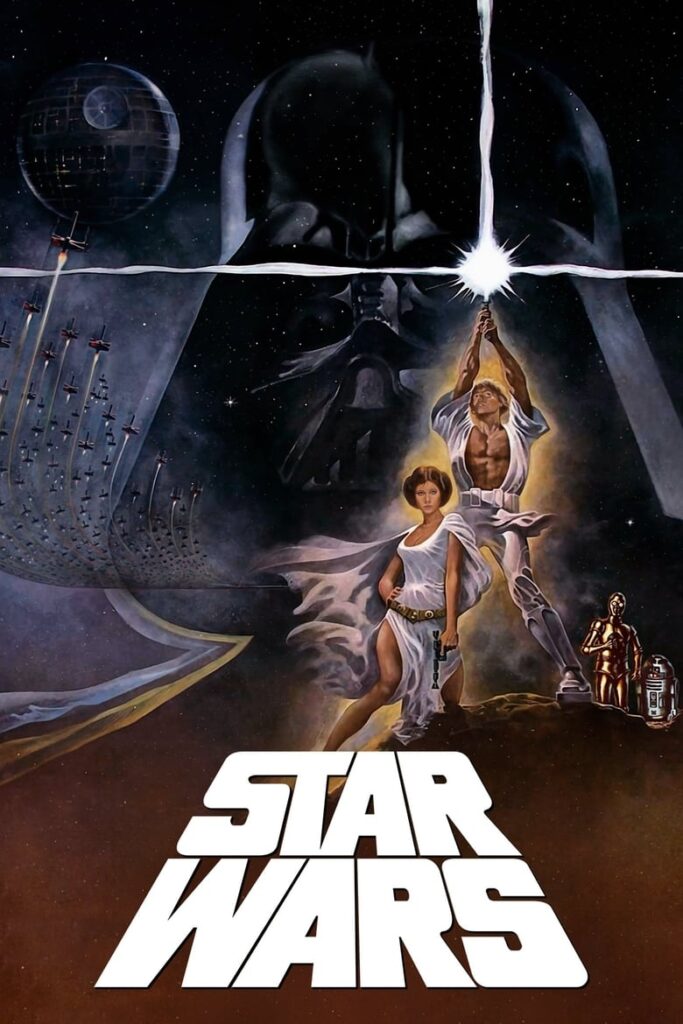
… and there’s a reason for that!
In a world of space battles, interplanetary travel and advanced technology, one of the defining features of modern society feels strangely absent: media.
Screens in Star Wars are mostly navigational tools, not sources of information or entertainment. Relationships emerge through physical encounters, often by chance. And when information needs to move from one place to another, it isn’t transmitted — it is carried. Stored inside a droid, like a message in a bottle.
No calls. No networks. No background noise of constant communication.
Information in Star Wars has weight. It travels through space, but not through systems. It depends on carriers, not connections. That alone places the film closer to a pre-modern world than a futuristic one. Technology is clearly there — but infrastructure for mass communication is not.
The more you notice it, the less it feels like a coincidence.
The absence of mass media in the original Star Wars isn’t just a product of its time. It points to something deeper — an underlying anti-modern logic.
In a galaxy that has mastered hyperspace travel, even the printing press seems oddly out of reach (a detail only awkwardly revised decades later in The Last Jedi).
A society without media
There is technology in Star Wars. But there are no mass media.
No television. No news. No visible infrastructure of information. Not even stable archives that preserve collective memory.
The Jedi, in the original film, have already faded into myth. They are remembered vaguely, if at all — as rumor, as legend.
In a media-saturated world, that would be almost impossible. But Star Wars isn’t structured like a media-saturated world. History here isn’t stored. It’s told.
And that changes everything.
A pre-modern logic
In modern narratives, technology transforms society. It produces new forms of knowledge, new publics, new systems of control and visibility.
None of that really happens in Star Wars.
There is an Empire. There is a Rebellion.
But there is no public sphere.
No press. No discourse. No visible mediation between power and population. Not even propaganda in the way modern regimes rely on it — which is striking, given how explicitly the Empire borrows its aesthetic language from the Third Reich.
Conflict is not negotiated. It is fought.
This is not a modern political space. It is a mythological one — where fate matters more than debate.
Memory without media becomes myth
Once you remove media, something else disappears with it: stable memory.
Without systems that record and reproduce knowledge, the past softens. It becomes flexible. It drifts.
That is why the Jedi don’t exist as history — but as belief.
And belief behaves differently than information. It doesn’t need to be verified.
Time moves in cycles, not forward
There is another consequence to this. Time in Star Wars does not really move forward.
Empires rise. Empires fall. Good turns into evil. Evil is redeemed.
And the structure remains.
George Lucas once described his films as “poetry that rhymes.”
It sounded like a vague metaphor.
But taken seriously, it points to something precise: The form stays the same. Only the surface changes.
This is not a modern understanding of time. It is a mythological one — cyclical, repetitive, resistant to progress.
Maybe the “balance of the Force” was never about resolving conflict.
Maybe it was always about accepting that it returns.
The real absence
What makes Star Wars feel the way it does is not just myth, or archetype, or even its characters. Knights, wizards and space pirates are only the surface.
It is what isn’t there.
No constant flow of information. No shared, stabilised version of reality. No system that keeps the past present.
Without media, nothing accumulates. Knowledge fades.
Power doesn’t need to justify itself publicly.
History becomes something that can be forgotten within a generation.
And that changes the texture of the world completely. It becomes quieter. Less mediated. Less explained. But also more fragile.
Because without media, there is no mechanism that prevents myth from replacing memory.
Maybe that’s why Star Wars feels so strangely timeless
Not because it shows us the future.
But because it removes one of the central conditions of modernity —
and lets everything else reorganise around that absence.
Films that feel closer to Star Wars than most sci-fi does
If Star Wars is shaped by myth, belief and the absence of media, it sits closer to these worlds than to most science fiction:
